If you’ve scrolled through TikTok comments and felt completely lost, you’re not alone. TikTok slang words and their meanings change so often that even people who use the app daily miss new terms. This guide breaks down the slang that actually matters right now, where it came from, and how to use it without sounding like you’re trying too hard.
Unlike a lot of slang roundups that just list random words with one-line definitions, this guide groups terms by how they’re actually used in conversation. That way, you’re not just memorizing a word — you’re learning when it fits, when it doesn’t, and what mistake to avoid when you try it out.
Why TikTok Slang Spreads So Fast
TikTok slang doesn’t move the way slang used to move. A word can go from a single video to millions of comment sections within a week. A few things drive that speed.
First, TikTok’s algorithm rewards sounds and phrases that get repeated. When a creator uses a word in a trending audio clip, thousands of other creators reuse that same clip, and the word rides along with it. Second, comment sections act like a testing ground — if a phrase gets engagement, other users copy it almost instantly to get the same reaction.
Third, a lot of TikTok slang gets picked up by younger users first, then filters into wider use through duets, stitches, and reaction videos. That’s why a term can feel brand new to adults while it’s already considered “old” among teens.
Finally, a large share of the words on this list didn’t start on TikTok at all. Many trace back to African American Vernacular English (AAVE), gaming communities, or older internet forums, and TikTok simply gave them a much bigger audience.
Core TikTok Slang Words and Their Meanings
Here’s where most guides just dump fifty words in a random order. Instead, this section groups slang by function, so you can find what you’re looking for and understand the pattern behind it.
Compliments and Approval
- Rizz — Short for charisma. Refers to someone’s ability to flirt or charm others smoothly. “He’s got rizz” means he’s good at attracting people.
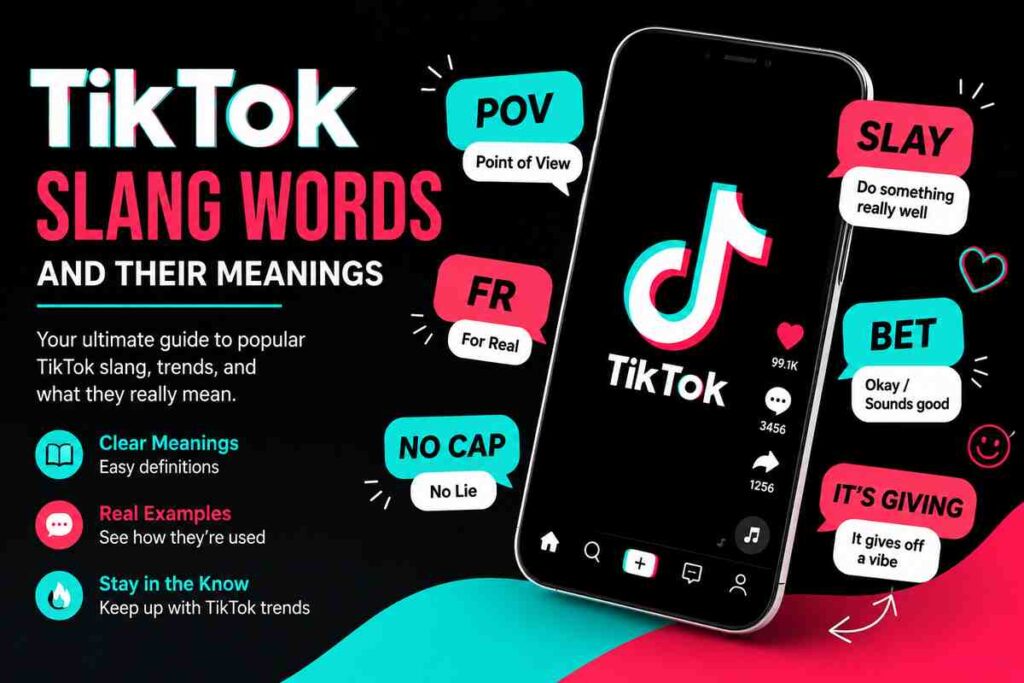
- Slay — Used when someone does something impressively well, often about style or confidence. “She slayed that outfit” means she looked great.
- GOAT — Stands for “Greatest Of All Time.” Used for someone or something considered the best in its category.
- Bussin’ — Describes food (or occasionally anything) that’s really good. “This pizza is bussin'” means it tastes great.
- W — Short for “win.” Used to celebrate a good outcome, as in “that’s a W” or simply commenting “W” under a post.
Insults and Callouts
- Mid — Means average or unimpressive. Calling something “mid” is a mild insult, softer than saying it’s bad.
- Sus — Short for suspicious. Comes from the game Among Us and now describes anything that seems shady or off.
- Cap / No Cap — “Cap” means a lie; “no cap” means “I’m not lying” or “for real.” “That’s cap” calls out a false statement.
- L — Short for “loss.” The opposite of a W. “That’s an L” means a bad outcome or embarrassing moment.
- Caught in 4K — Means someone got caught doing something on camera or with undeniable proof, similar to being “caught red-handed.”
Reactions and Exclamations
- Skibidi — Originated from the “Skibidi Toilet” video series and now gets used loosely to mean something is either good, bad, or just chaotic, depending on context and tone.
- Gyat — An exaggerated exclamation, often reacting to someone’s appearance. Widely used among younger TikTok users, sometimes as a standalone reaction.
- Fanum Tax — Refers to taking a portion of someone else’s food, named after streamer Fanum. “He fanum taxed my fries” means he took some without asking.
- Sigma — Describes someone seen as independent and unbothered by social hierarchies, often used half-seriously or as a joke about lone-wolf behavior.
- Ohio — Used as shorthand for something bizarre or absurdly out of the ordinary, regardless of whether it actually relates to the state.
Relationships and Social Life
- Delulu — Short for delusional. Often used self-deprecatingly, as in “I’m delulu for thinking he’ll text back.”
- Situationship — A relationship that isn’t clearly defined — more than friends, but without the label of a couple.
- Vibe Check — A quick read on someone’s mood or energy. “Vibe check” can also mean checking whether a place or moment feels good.
- Main Character Energy — Acting like the lead character in your own story, usually meant as a compliment about confidence.
- Ick — A sudden feeling of being turned off by someone, often triggered by a small, specific action. “He gave me the ick” means something he did killed the attraction.
Money and Hustle Slang
- CEO of ___ — Used jokingly to say someone is extremely good (or extremely bad) at a specific thing. “She’s the CEO of overthinking.”
- Secure the Bag — Means to make money or take advantage of a good opportunity.
- Big Back — A newer term used mostly in school settings, generally as a lighthearted insult or tease among peers.
Quick Abbreviations Worth Knowing
- Fr — “For real,” used to agree or emphasize sincerity.
- Ngl — “Not gonna lie,” used before an honest or blunt statement.
- Ate — Means someone did something exceptionally well. “She ate that performance.”
- Periodt — Adds finality to a statement, similar to saying “and that’s that.”
- Crash Out — Refers to someone losing their composure or reacting dramatically to a stressful situation.
New and Trending TikTok Slang Worth Watching
Slang has a short shelf life, and some terms are still building momentum rather than settling into everyday use. Keeping an eye on these helps you understand where TikTok slang words and their meanings are heading next, not just where they’ve already been.
- Fairs — A British slang term that crossed over into wider meme culture, generally used as a casual way of agreeing or accepting something without much fuss.
- Geeg — An emerging term tied to Gen Z internet humor, typically used as a reaction or descriptor in comment sections rather than in spoken conversation.
- Goofinator — A playful, exaggerated term for someone acting silly or clumsy, often used affectionately rather than as a real insult.
- Twin — Used to address a close friend, similar to “bestie,” regardless of whether the two people actually look alike.
- Smooth Brain — A joking insult suggesting someone made an obviously bad decision, implying a lack of “wrinkles” from deep thinking.
Because this category shifts monthly, treat any specific new term as temporary. If a word feels forced or overexplained by the time you read about it, it’s probably already fading.
How to Use TikTok Slang Without Sounding Forced
Learning the definition of a word is only half the job. Using it naturally takes a bit more attention to context, tone, and timing.
Start by watching how a term gets used across several videos before trying it yourself. Slang often carries a tone — sarcastic, playful, sincere — that a plain definition doesn’t capture. Using “mid” with genuine enthusiasm, for example, sends the wrong signal entirely.
Pay attention to who uses a word and where. Some slang is mostly used by teenagers in school settings, while other terms show up more in gaming communities or adult humor accounts. A term that fits one space can feel out of place in another.
Match the setting, too. Slang that works fine in a text to a friend can feel awkward in a work Slack message or a formal email. Reading the room matters more than knowing the definition.
Finally, don’t overuse a single term. Repeating the same slang word in every sentence reads as try-hard, even if the word itself is currently popular.
Common Mistakes People Make With TikTok Slang
A few patterns show up again and again when people misuse TikTok slang.
- Using outdated terms as if they’re current. Slang moves fast, and a word that felt fresh six months ago can already sound dated.
- Misreading tone. Some slang is sarcastic by nature. Taking it literally, or using it literally, changes the meaning entirely.
- Overexplaining a term mid-conversation. Stopping to define a word you just used usually undercuts the point of using it casually.
- Applying slang to the wrong audience. A term aimed at teens can land oddly when used with coworkers or older relatives who don’t share the same context.
- Assuming every platform shares the same slang. Some terms are TikTok-specific, while others carry different meanings on Twitter/X, Discord, or gaming platforms.
A Practical Guide for Parents and Teachers
If you’re trying to keep up with TikTok slang words and their meanings for a child or student rather than for yourself, a slightly different approach helps.
Rather than memorizing every term, focus on the categories that come up most: compliments, insults, and reactions. Kids typically use only a handful of active terms at a time, so learning those specific words matters more than trying to cover the whole list.
It also helps to ask directly rather than guess. Most kids don’t mind explaining a term when asked in a casual, non-judgmental way. That conversation often reveals more about tone and context than any online guide can.
Be aware that some slang carries hidden or coded meanings, especially around sensitive topics. If a phrase feels unusual or oddly specific, a quick search alongside the child’s name or platform (not the term itself) can clarify whether it’s harmless fun or something that needs a closer conversation.
Where TikTok Slang Actually Comes From
A lot of TikTok slang isn’t new — it’s borrowed, remixed, or repackaged from existing sources. Understanding the origin makes the meaning easier to remember and gives useful context for how a word is meant to be used.
Many widely used terms, including several compliments and reaction words, have roots in African American Vernacular English and were adopted more broadly as they spread through music, sports commentary, and social media. Gaming culture contributes heavily as well — terms like “sus” and “sigma” gained mainstream traction through gaming livestreams before TikTok picked them up.
Meme culture and reaction videos add another layer, turning random moments — a phrase from a video, a nickname for a streamer, a joke from a comment section — into words with staying power. That mixed origin is part of why TikTok slang feels so unpredictable: it isn’t one dialect, but several different influences colliding at high speed.
Also, read about Internet Acronyms.
Frequently Asked Questions
Is TikTok slang the same as Gen Z slang?
Not exactly. There’s heavy overlap, but TikTok slang includes terms used by multiple age groups, while Gen Z slang can include words that never actually trend on TikTok itself.
Why does TikTok slang change so quickly?
Because trends spread through short videos and comment sections, a word can peak and fade within weeks. What feels new one month can feel outdated the next.
Should adults avoid using TikTok slang entirely?
Not necessarily, but tone and setting matter. Using a term casually with friends is different from using it in professional or unfamiliar settings, where it can come across as forced.
Where can I find the newest TikTok slang as it emerges?
Comment sections on trending videos, along with TikTok’s own “Discover” pages, tend to surface new terms before they become widely known.
Do TikTok slang words have consistent meanings?
Not always. Some words shift meaning depending on tone, sarcasm, or the specific community using them, which is why context matters as much as the definition itself.
Key Takeaways
TikTok slang words and their meanings shift constantly, but the patterns behind them stay fairly consistent. Compliments, insults, reactions, and relationship terms make up most of what you’ll encounter, and understanding the category a word belongs to makes it much easier to guess how it’s meant to be used.
Rather than trying to memorize every term that appears, focus on the words that show up most often in your own feed or conversations. Watch how people around you use them, pay attention to tone, and don’t be afraid to ask what a term means if you’re unsure — that’s usually faster and more accurate than searching for a definition online.
Slang will keep changing. The words in this guide that feel fresh today may sound dated within a year. What stays useful is knowing how to read the pattern, so you can pick up the next wave of terms just as quickly as this one.