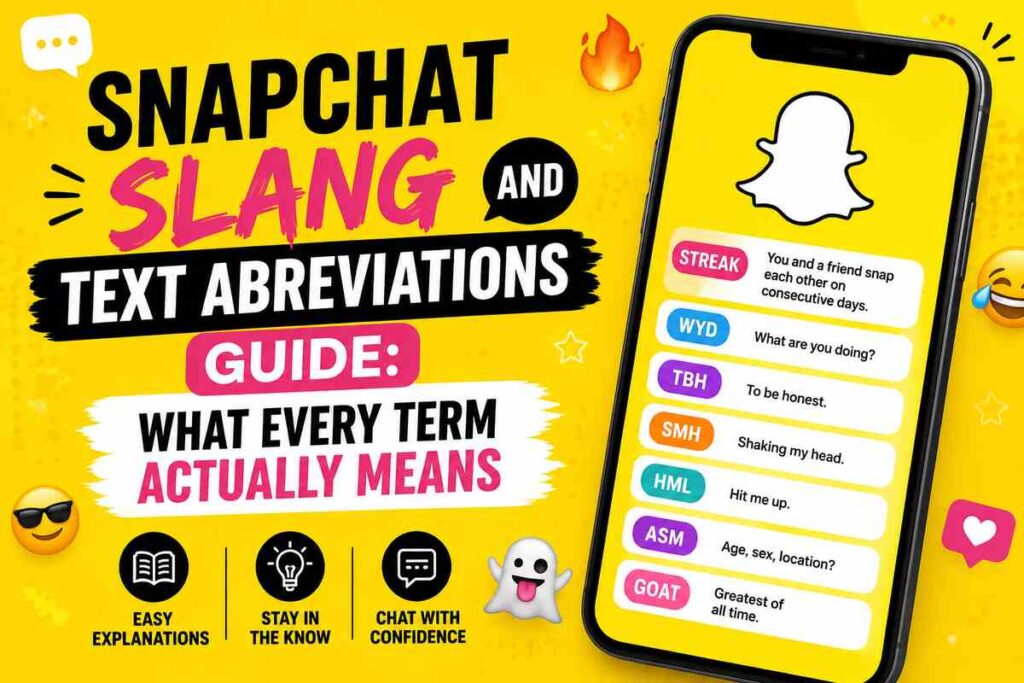
Open any Snapchat conversation and you’ll run into a wall of letters that barely look like English. WYD, GYAT, NRS, ASL — the shorthand moves fast, and it changes just as fast. This Snapchat slang and text abbreviations guide breaks down what these terms mean, how people actually use them, and where they came from, so you’re never left guessing in a chat.
Whether you just downloaded the app, you’re a parent trying to understand your kid’s messages, or you’re a regular user who wants to fill in a few gaps, this guide covers the terms that show up the most and the context that most lists skip.
Why Snapchat Has Its Own Language
Snapchat was built around speed. Photos and videos disappear, streaks reset daily, and conversations move quickly between dozens of friends. Typing full sentences slows that down. Abbreviations let people respond in seconds instead of minutes.
A lot of this shorthand isn’t unique to Snapchat. Terms like TBH, IDK, and OMG showed up in texting long before Snapchat existed. But Snapchat added its own layer on top, built around features the app is known for: streaks, snap scores, stories, and the Snap Map. That’s why some abbreviations on this list won’t make sense anywhere else.
The slang also skews younger. Snapchat’s core user base is teens and young adults, so a lot of terms come from group chats, TikTok trends, and school hallway conversations before they ever reach a dictionary. That’s part of why the list keeps growing and why older terms quietly disappear.
Snapchat-Specific Terms You Need to Know
These abbreviations relate directly to how Snapchat works. You won’t find most of them used the same way on other apps.
SB — Snap Back. Someone is asking you to reply with a snap of your own, usually a photo or short video, instead of just texting back.
SFS — Snap For Snap (or Shoutout For Shoutout). This is a trade. One person posts a snap promoting another user’s account, and that user does the same in return. It’s common among people trying to grow their friend list or following.
ESB — Everyone Snap Back. A group message asking all recipients to respond so a streak or group snap chain doesn’t break.
NRS — Not Really Snapping or No Replies. Someone uses this to say they won’t be responding for a while, often because they’re busy, asleep, or taking a break from their phone.
AMOS — Add Me On Snapchat. A direct request to be added as a friend, usually shared alongside a username on another platform like Instagram or TikTok.
WCW / MCM — Woman Crush Wednesday / Man Crush Monday. These are posting trends where users share a photo of someone they’re interested in or admire on the matching day of the week.
Streaks. Not an abbreviation, but essential context. A streak happens when two people send snaps back and forth for consecutive days. The app tracks the count with a fire emoji next to the streak number, and many terms on this list (SB, ESB, NRS) exist specifically to manage streaks.
Snap Score. This is a running total based on how many snaps you’ve sent and received. It’s not the same as your friend count, and a high score usually signals an active user rather than a popular one.
General Texting Abbreviations Used Constantly on Snapchat
These terms aren’t exclusive to Snapchat, but they show up in nearly every conversation on the app.
TBH — To Be Honest. Used before sharing an honest opinion, often one that might be blunt or unexpected. It also became its own trend format, where people post “TBH” and let friends comment their honest thoughts.
HRU — How Are You? A quick check-in, usually opening a conversation after some time apart.
WYD — What You Doing? Casual and open-ended, often used to start a conversation or figure out someone’s plans.
WYA — Where You At? Asks for someone’s current location or general whereabouts, often when trying to meet up.
HMU — Hit Me Up. An invitation to reach out later, whether that’s to talk, hang out, or make plans.
IDK / IDC — I Don’t Know / I Don’t Care. Standard shorthand for a lack of information or a lack of interest in the outcome.
FR — For Real. Used to emphasize that something is true or serious, often as a one-word reply agreeing with a previous message.
NGL — Not Gonna Lie. Similar to TBH, this signals that an honest, sometimes unflattering statement is coming next.
GYAT — an exaggerated reaction, often to someone’s appearance. It came from internet meme culture and spread through TikTok before showing up regularly in Snapchat captions and comments.
KMS / KYS. These letters stand for phrases related to self-harm. They’re sometimes used as dark humor in casual conversation, but the literal meaning is serious enough that context matters. If someone uses these terms and seems genuinely distressed, take it seriously rather than assuming it’s a joke.
Common Questions and Answer Terms
Some Snapchat slang exists specifically to ask or answer quick questions. These are worth learning as a group because they often appear together in the same conversation.
WYLL — What You Like Lately? Asks about someone’s recent interests, music, or general mood.
ASL — Age, Sex, Location. An older internet abbreviation that’s still used to ask basic identifying details about someone new. This one deserves caution: sharing personal details like age and location with strangers online carries real privacy risk, especially for younger users.
WYF — Where You From? A simpler, safer version of ASL that just asks about someone’s general location, like a city or region.
IFG — I Feel Good. Used to express a positive mood without writing out a full sentence.
WTM — What’s The Move? Asks what the plan is, often used when a group is deciding what to do next.
Reaction and Emotion Shorthand
A large chunk of Snapchat slang exists just to express a quick reaction. These terms carry tone rather than information.
STG — Swear To God. Adds emphasis to a statement, usually placed at the start or end of a sentence.
LWK — Low-Key. Suggests something is true to a mild or understated degree, often used to soften an opinion.
HWK — Highly aware or sometimes confused with Homework depending on context. Context in the conversation usually makes the meaning clear.
GTS — Go To Sleep. Can be a friendly sign-off at the end of the night, though some use it to mean “good times” depending on the conversation.
HW — Homework. Common among students complaining about schoolwork or explaining why they’re slow to reply.
FYP — For Your Page. Borrowed directly from TikTok’s “For You Page,” this refers to content that feels tailor-made for someone’s interests.
How Generations Use Snapchat Slang Differently
One thing most guides skip is that slang usage isn’t uniform across age groups, and understanding this helps explain why some terms feel confusing depending on who sent them.
Teens and younger users tend to use the newest slang first, picking it up from TikTok trends and group chats before it spreads elsewhere. Terms like GYAT or FYP usually start in this group.
Older Gen Z users and young millennials still rely on classics like TBH, HMU, and NGL, but they’re less likely to adopt the newest meme-driven terms right away. Many treat slang as optional rather than constant.
Parents and older adults on Snapchat mostly stick to plain language or a handful of familiar abbreviations like LOL and OMG. If you’re a parent trying to read your child’s messages, this guide is a starting point, but slang changes often enough that checking in with your child directly is usually more reliable than any list.
When to Use Snapchat Slang (and When Not To)
Slang works well with friends in casual, low-stakes conversations. It fits the tone of quick back-and-forth chats and helps messages feel natural rather than stiff.
It doesn’t translate well outside that context. Sending abbreviations in a message to a teacher, a coach, or a potential employer can come across as careless, even if that’s not the intent. The same applies to family group chats with older relatives who may not recognize the terms at all.
A good rule of thumb: match the tone of the person you’re talking to. If they’re texting in full sentences, respond the same way. If they’re already using shorthand, it’s fine to match it.
Common Mistakes People Make With Snapchat Slang
Using outdated terms. Slang has a short shelf life. A term that felt current two years ago can sound out of place today. If you’re unsure whether something is still used, pay attention to how often you actually see it in real conversations.
Assuming every abbreviation is Snapchat-specific. Many terms, like TBH or IDK, are just general texting shorthand that happens to show up on Snapchat too. Treating every acronym as an app-specific mystery makes the learning curve feel steeper than it is.
Ignoring context clues. The same letters can mean different things depending on the conversation. GTS can mean “go to sleep” or “good times.” Reading the full message usually clears up the ambiguity faster than guessing from the abbreviation alone.
Overusing slang in serious conversations. If a friend is upset or dealing with something difficult, leaning on casual abbreviations can come across as dismissive. Save the shorthand for lighter exchanges.
Sharing personal information because of a casual-sounding question. Terms like ASL sound harmless, but answering with real details to someone you don’t know in person isn’t a good habit, particularly for younger users.
Practical Tips for Keeping Up With New Slang
Snapchat slang changes constantly, and no single guide will stay complete forever. A few habits make it easier to keep up.
- Pay attention to context before assuming a definition. Most terms make more sense once you see how they’re used in a real message.
- Ask directly if you’re unsure. A quick “what does that mean?” is normal and won’t come across as awkward.
- Don’t feel pressured to use every term you learn. Slang should feel natural, not forced into every message.
- If you’re a parent, focus on understanding tone and intent rather than memorizing every acronym. Most slang is harmless, but a few terms, like those referencing self-harm, deserve a closer look if they appear in a serious context.
Frequently Asked Questions
1- What does SB mean on Snapchat?
SB stands for Snap Back. It’s a request for someone to reply with a snap rather than a text message.
2- What does NRS mean on Snapchat?
NRS usually means “Not Really Snapping” or that someone isn’t replying for a while, often due to being busy or unavailable.
3- Is Snapchat slang only used by teenagers?
No. Teens tend to adopt new slang first, but plenty of adults use common abbreviations like TBH, HMU, and NGL in everyday conversations.
4- Does Snapchat slang mean the same thing on other apps?
Sometimes. General texting terms like IDK or OMG carry the same meaning across platforms. Snapchat-specific terms tied to streaks or snap scores, like SB or ESB, are less common elsewhere.
5- What should I do if I see concerning slang like KMS in a conversation?
Take the context seriously. If someone appears genuinely distressed rather than joking, it’s worth checking in with them directly or encouraging them to talk to someone they trust.
Key Takeaways
Snapchat slang exists to keep conversations quick and casual, and most of it is easy to pick up once you see it in context a few times. The Snapchat-specific terms — SB, ESB, NRS, AMOS — connect directly to features like streaks and snap scores, while general texting abbreviations like TBH, WYD, and HMU show up across almost every messaging app.
Also, read about What Does TS PMO Mean in Texting.
The best way to get comfortable with this shorthand is simple: read messages in full context, ask when something isn’t clear, and match your tone to whoever you’re talking to. Slang will keep changing, but those habits will keep working no matter what new terms show up next.